


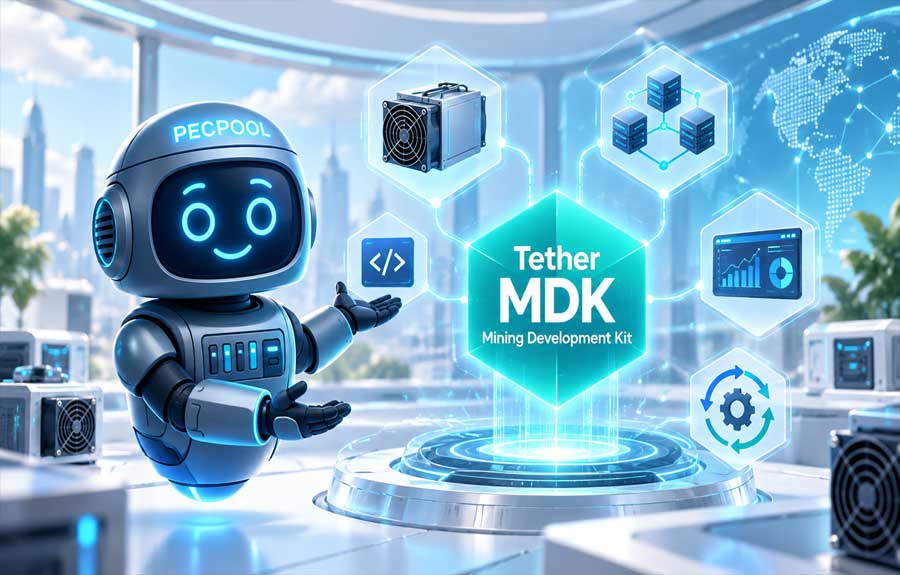
Tether has brought together 15 participants from the Bitcoin mining industry to support its open-source Mining Development Kit (MDK). The initiative aims to simplify communication between mining hardware, software platforms and pool services, potentially changing how operators manage increasingly complex mining facilities.
Running a Bitcoin mining operation is no longer simply a matter of connecting machines to a pool and monitoring the resulting hashrate.
Large facilities often operate hardware from several manufacturers, alongside cooling equipment, power-management systems and monitoring platforms that were never designed to communicate with one another.
Tether believes a shared software interface could help address that problem.
On October 24, the company announced that 15 participants across the Bitcoin mining industry had committed to developing and maintaining integrations with its open-source Mining Development Kit, or MDK.
The participants include major hardware manufacturers such as BITMAIN, MicroBT and Canaan, as well as mining infrastructure and pool operators including Foundry Digital, F2Pool, Luxor Technology, EMCD, OCEAN and SpiderPool.
Why Mining Software Remains Fragmented
A mining farm running equipment from multiple manufacturers may need several management tools to collect performance statistics, monitor temperatures or manage device settings.
Even when the same information is available from different machines, their software interfaces and command structures may be incompatible.
This creates additional work for operators and developers, particularly when facilities add new equipment or expand across several locations.
MDK attempts to provide a common software layer above those existing systems.
Each participating organization can develop a component known as an MDK Worker, which translates its hardware or service interface into a common format.
Applications built around MDK can then communicate through that shared interface rather than requiring a separate integration for every supported manufacturer.
Mining Pools Are Part of the Picture
The involvement of mining pools is an important aspect of the announcement.
MDK is not intended to cover ASIC hardware alone. Its proposed architecture can also connect mining services and supporting infrastructure through compatible integrations.
That could eventually help developers combine device monitoring, operational data and pool-related information within more unified management applications.
However, MDK should not be confused with a replacement for Stratum or Bitcoin's mining process.
Its purpose is software interoperability and infrastructure management. It does not change how miners compete to produce blocks or how Bitcoin's consensus rules operate.
Automation Creates New Opportunities and Responsibilities
Tether also sees MDK as a foundation for more automated mining operations.
With a consistent interface, software could analyze equipment performance, identify abnormal conditions and coordinate monitoring across different hardware environments.
The distinction between monitoring equipment and controlling it remains critical.
Actions such as restarting a miner or changing its operating mode can affect production, so any automated control system needs clearly defined permissions, authentication and operational safeguards.
A common interface may simplify those tasks, but it does not automatically guarantee that every implementation will be secure.
A Development Project, Not a Finished Industry Standard
Tether outlined MDK version 0.11 around the October 23–24 Plan ? Forum in Lugano and is targeting its first stable 1.0 release by the end of 2026.
The project is already open source, allowing developers to explore its architecture and test integrations.
Nevertheless, commitments from industry participants should not be mistaken for completed deployments.
Tether has not published comprehensive figures showing how many production machines are operating through MDK, how much electricity the framework saves or whether it reduces maintenance costs under real operating conditions.
Those results will matter more than the number of companies supporting the initial announcement.
What This Could Mean for Bitcoin Mining
If the initiative succeeds, mining operators may eventually gain more flexibility when choosing hardware and management software.
Instead of maintaining separate integrations for every new device family, developers could build tools around a common interface supported by multiple manufacturers and service providers.
The practical benefits would depend on compatibility, reliability, security and long-term maintenance.
For an industry increasingly focused on operational efficiency, open and interoperable mining software could become an important part of the infrastructure behind the hashrate.